

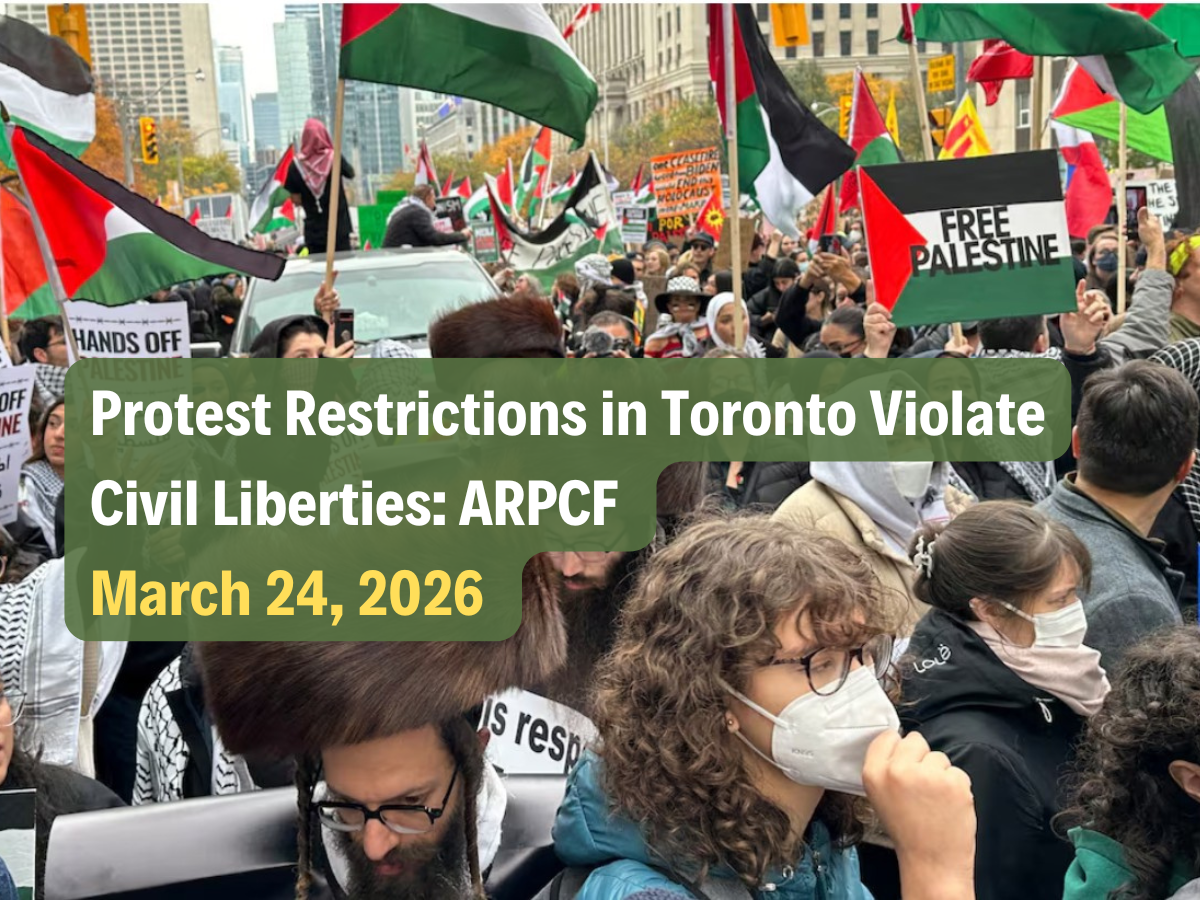
Montreal, March 24, 2026 — The Anti-Racism Program of the CJPME Foundation (ARPCF) expresses serious concerns over the decision by Toronto Police to prohibit pro-Palestinian demonstrations on residential streets in the York Centre area. While authorities have framed this measure as a response to safety concerns, the APRCF argues that restricting access to public space based on the political content or location of protest raises profound civil liberties issues. The right to peaceful assembly is a cornerstone of a democratic society, and any limitation on that right must be narrowly justified, evidence-based, and applied without discrimination.
The ARPCF underscores that such geographically targeted restrictions risk establishing a troubling precedent whereby certain communities or neighbourhoods become effectively ‘off-limits’ for political expression. “When decisions about where people can protest are shaped by the perceived sensitivity of a community or the political nature of a cause, it creates a hierarchy of rights that undermines equality before the law,” says Jamila Ewais, lead researcher of the ARPCF. Civil liberties protections must apply consistently, regardless of the issue being protested or the communities involved.
Findings from the ARPCF’s recent report on the policing of pro-Palestinian activism in Canada, titled “Policing Palestine Solidarity: A Crisis of Civil Liberties in Canada (2021-2025),” highlight a broader pattern in which this anti-racist movement has been subject to disproportionate scrutiny and restriction. Despite the overwhelming majority of demonstrations being peaceful, pro-Palestinian protests have faced elevated levels of police intervention, surveillance, and control compared to other social movements. The use of pre-emptive restrictions—such as limiting protest locations—reflects a shift away from facilitating lawful assembly toward managing and containing dissent, particularly when it challenges prevailing political narratives.
The ARPCF calls on municipal authorities and police services to ensure that public safety measures do not come at the expense of fundamental freedoms. Safeguarding communities and protecting civil liberties are not mutually exclusive goals. Transparent criteria, clear evidence, and consistent application of the law are essential to maintaining public trust. Canada’s democratic institutions must remain vigilant against the normalization of restrictions that disproportionately affect certain political expressions, as such measures risk eroding the very freedoms they are meant to protect.
About the ARPCF – The mandate of the Anti-Racism Program of the CJPME Foundation (ARPCF) is to create public awareness about racism in Canada. This mandate falls in line with the Foundation’s broader purpose of monitoring and combating manifestations of racism, xenophobia, and discrimination by increasing public awareness of such biases.
For more information, please contact Jamila Ewais, 514-389-8668
ARPCF, [email protected] www.cjpmefoundation.org
The whole or parts of this press release can be reproduced without permission.
– 30 –